The Headline Numbers
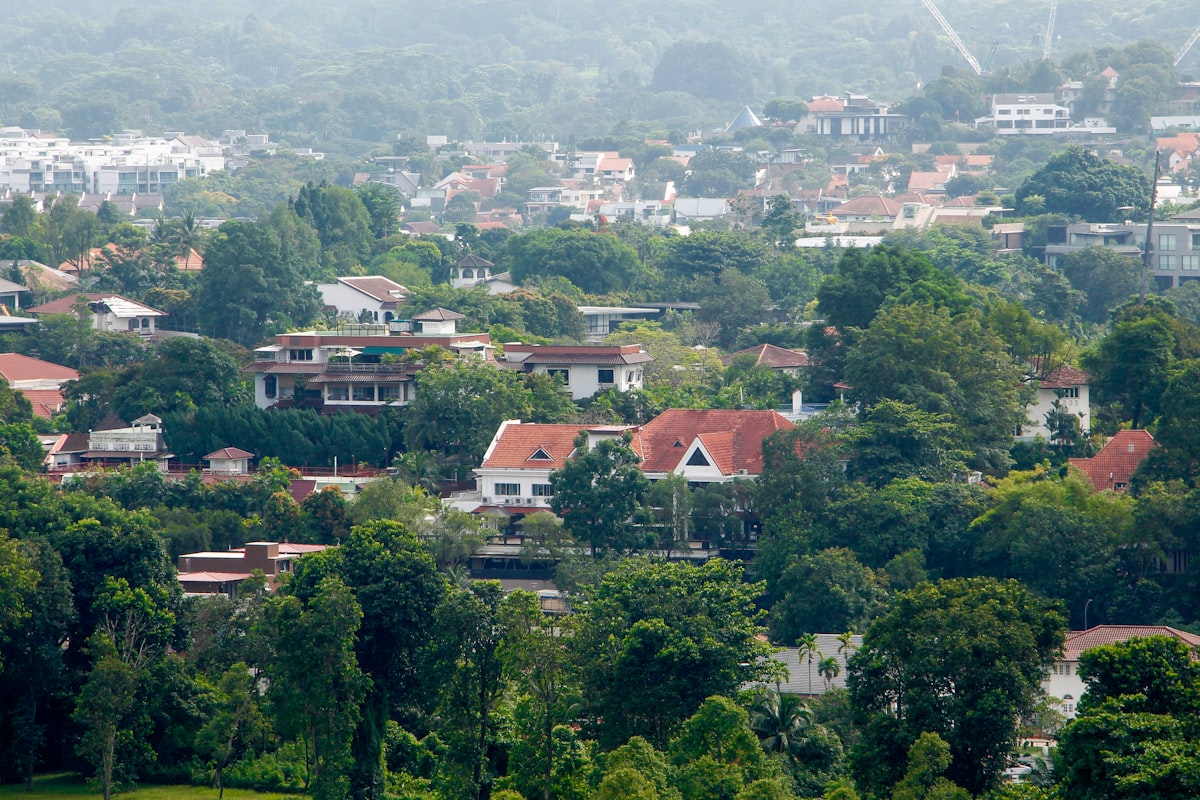
Landed property was the top-performing segment in Singapore's private residential market in 2025. According to URA data, the landed price index rose 7.6% for the year, more than double the overall private market's 3.4% gain. Transaction volume hit 1,852 units, the highest since 2021.
Three structural factors drove this: fixed supply (only ~73,000 landed homes versus roughly 350,000 condos), domestic wealth concentration, and limited foreign competition (60% ABSD for foreigners keeps the market overwhelmingly local).
Price Snapshot: Most Expensive and Most Affordable Districts
| District | Area | Median Price |
|---|---|---|
| D4 | Sentosa, Harbourfront | S$13.60M |
| D11 | Newton, Novena | S$11.18M |
| D3 | Queenstown, Tiong Bahru | S$10.99M |
| ... | ||
| D25 | Woodlands | S$3.45M |
| D18 | Pasir Ris, Tampines | S$2.85M |
| D22 | Boon Lay, Jurong | S$2.47M |
See Detailed view for the full top 5 and bottom 5 with PSF data, plus pricing by property type and tenure across CCR, RCR, and OCR.
What the Detailed View Includes
The full article is a complete agent reference tool covering:
- District-by-district pricing with median prices, PSF, and transaction volumes for the most active and most affordable districts
- Price by type and tenure tables for freehold and leasehold detached, semi-D, and terrace across all three regions
- URA land size minimums with minimum plot sizes, frontage, site coverage, and building height rules
- Key landed estates in Districts 10, 11, 4, 15, 16, 19, 20, 21, 28, 22, and 18, organised by price tier
- Financing section with LTV limits, TDSR income thresholds, the bank valuation gap (a landed-specific challenge), and CPF usage rules
- Property tax rate tables with worked examples showing annual tax for a semi-D (S$2,720) versus a detached home (S$8,620 owner-occupied, S$25,200 rented out)
- Rental yield data by region and property type, with monthly rental ranges and a comparison to condo yields
- ABSD and SSD tables including the July 2025 SSD extension and foreign ownership rules
- GCB segment analysis with 2025 transaction data (36 deals, S$1.36B) and the S$148M Peirce Road record sale
- 2026 outlook with ERA projections (1,750 to 1,950 transactions, 5 to 7% price growth)
- 3 ready-to-send WhatsApp templates for landed buyer outreach, valuation updates, and HDB upgrader conversations
Key Takeaways
- Landed prices rose 7.6% in 2025, the strongest segment in the private market.
- D4 (Sentosa) commands the highest median at S$13.6M; D22 (Jurong) offers the lowest entry at S$2.47M.
- Freehold carries a 30 to 50% premium over leasehold equivalents.
- Supply is structurally constrained at ~73,000 total landed homes.
- Bank valuations for landed frequently come in below purchase price, increasing cash outlay.
- Non-owner-occupied property tax can hit 36% marginal rate on higher AVs.
- Gross rental yields of 2.5 to 3.8% trail condos but stronger capital appreciation compensates.
Share market data with clients faster
PropPal turns your WhatsApp conversations into a structured CRM so you can follow up at the right time with the right data.
Just $1 a day? Try PropPal. Setup takes 5 minutes. Cancel anytime.Switch to Detailed above for the full district-by-district breakdown, financing and tax reference tables, 3 ready-to-send WhatsApp templates, and our analysis of the GCB and rental yield segments.
How the Landed Market Performed in 2025
Landed property was the top-performing segment in Singapore's private residential market in 2025. The URA Property Price Index for landed homes rose 7.6% for the year, more than double the overall private market's 3.4% gain and a sharp acceleration from just 0.9% in 2024. Transaction volume hit 1,852 units, the highest since 2021.
Three structural factors drove this:
- Fixed supply. Singapore has approximately 73,000 landed properties, compared to roughly 350,000 condominiums. The government's long-term land use strategy prioritises high-density housing, so new landed stock is unlikely to increase meaningfully.
- Domestic wealth concentration. Ultra-high-net-worth buyers, multi-generational family wealth, and upgraders from large condominiums continued to absorb available stock.
- Limited foreign competition. The Residential Property Act restricts foreign ownership of landed homes, and the 60% ABSD rate for foreigners further limits cross-border demand. As Singapore's safe-haven status strengthens in 2026, domestic buyers remain the primary demand source for landed.
According to ERA Research, District 19 (Serangoon, Hougang, Punggol) was the most active district by volume with 309 landed transactions in 2025, while Districts 10 and 11 dominated by value.
Median Landed Property Prices by District in 2026
The landed property price gap across Singapore's districts is substantial. Based on URA caveated transaction data from January 2025 to January 2026, the most expensive district (D4, Sentosa) commands a median of S$13.60M while the most affordable (D22, Jurong) sits at S$2.47M, a 5.5x spread.
Top 5 Most Expensive Districts
| District | Area | Median Price | Median Size (sq ft) | Median PSF |
|---|---|---|---|---|
| D4 | Sentosa, Harbourfront, Telok Blangah | S$13.60M | ~4,200 | ~S$3,238 |
| D11 | Newton, Novena, Watten Estate | S$11.18M | ~3,800 | ~S$2,942 |
| D3 | Queenstown, Tiong Bahru | S$10.99M | ~3,500 | ~S$3,140 |
| D10 | Bukit Timah, Holland, Tanglin | S$10.50M+ | varies widely | varies |
| D9 | Orchard, River Valley | S$9.80M+ | ~3,200 | ~S$3,063 |
District 4's top position is driven by Sentosa Cove, Singapore's only resort-style landed enclave where waterfront bungalows with yacht berths command premium pricing. District 10, despite containing the largest concentration of Good Class Bungalows, shows a wider spread, from S$6M terrace houses to S$148M GCBs, which can pull the median depending on the transaction mix in any given period.
Top 5 Most Affordable Districts
| District | Area | Median Price | Median Size (sq ft) | Median PSF |
|---|---|---|---|---|
| D22 | Boon Lay, Jurong, Tuas | S$2.47M | ~2,200 | ~S$1,123 |
| D18 | Pasir Ris, Tampines | S$2.85M | ~2,400 | ~S$1,188 |
| D25 | Woodlands, Admiralty | S$3.45M | ~2,600 | ~S$1,327 |
| D27 | Sembawang, Yishun | S$3.50M | ~2,500 | ~S$1,400 |
| D19 | Serangoon, Hougang, Punggol | S$3.65M | ~2,400 | ~S$1,521 |
District 22 is consistently the lowest entry point for landed property in Singapore. For agents working with first-time landed buyers or HDB upgraders, the western and northern districts offer the most accessible pricing.
How Much Does Each Landed Property Type Cost?
Property type and tenure are the two largest price determinants in the landed segment. The gap between a freehold detached house in the Core Central Region and a 99-year leasehold terrace in the Outside Central Region can exceed S$14M. Freehold commands a 30 to 50% premium over leasehold for equivalent property types in the same region.
Freehold / 999-Year Leasehold
| Property Type | CCR | RCR | OCR |
|---|---|---|---|
| Detached | S$18.37M | S$12.48M | S$9.18M |
| Semi-Detached | S$9.35M | S$6.80M | S$5.63M |
| Terrace | S$6.80M | S$4.44M | S$4.32M |
99-Year Leasehold
| Property Type | CCR | RCR | OCR |
|---|---|---|---|
| Detached | S$12.50M+ | S$8.50M+ | S$6.00M+ |
| Semi-Detached | S$6.50M+ | S$4.80M+ | S$3.80M+ |
| Terrace | S$4.50M+ | S$3.20M+ | S$2.80M+ |
Key insight for agents: This freehold premium has been widening, not narrowing, as buyers increasingly view freehold landed as a generational asset rather than a pure investment.
What Are the URA Minimum Plot Sizes for Landed Property?
URA's minimum plot size and frontage requirements directly affect property classification and pricing. A plot of 399 sqm cannot be classified as a detached house regardless of how it is built. These thresholds explain pricing tiers and constrain what buyers can do with their land.
Minimum Plot Size and Frontage
| Property Type | Min. Plot Size | Min. Frontage |
|---|---|---|
| Terrace (intermediate) | 150 sqm | 6m |
| Terrace (corner) | 200 sqm | 8m |
| Semi-Detached | 200 sqm | 8m |
| Detached (Bungalow) | 400 sqm | 10m |
| Good Class Bungalow | 1,400 sqm (~15,070 sq ft) | 18.5m |
Maximum Site Coverage and Building Height
| Property Type | Max. Site Coverage | Max. Height |
|---|---|---|
| Semi-Detached | 45% | 2 storeys (12m) or 3 storeys (15.5m) |
| Detached (Bungalow) | 50% | 2 or 3 storeys depending on zoning |
| Good Class Bungalow | 40% | 2 storeys only |
Most landed estates are zoned for 2 storeys. URA uses envelope control (a 3D building envelope) rather than simple storey limits, so the entire structure including roof forms and attic spaces must fit within the permitted envelope. When clients ask about rebuilding, the first step is checking the URA Master Plan zoning for that specific plot.
Turn landed market knowledge into closed deals
PropPal keeps every WhatsApp conversation organised so you never lose a warm landed lead to admin friction.
Just $1 a day? Try PropPal. Setup takes 5 minutes. Cancel anytime.The GCB Segment: Where the Ultra-Premium Deals Happen
Good Class Bungalows are the apex of Singapore's residential market. Only approximately 2,800 GCBs exist across 39 gazetted areas, and they can only be purchased by Singapore Citizens. In 2025, at least 36 GCBs changed hands, totalling an estimated S$1.36 billion when off-market transactions are included. According to Savills, 25 caveated deals were worth S$1.12 billion.
The headline transaction was a freehold GCB on Peirce Road (District 20) that sold for S$148 million, an 80,448 sq ft site at S$1,840 per square foot. The buyer was Victor Soh Choon Lai, managing director of Pinnacle Assets Group. GCB pricing typically starts at S$20M for smaller plots and exceeds S$100M for prime positions in Nassim Road, Queen Astrid Park, or Dalvey Road.
Key Landed Estates Every Agent Should Know
Singapore's landed estates vary dramatically by price, character, and buyer profile. Here are the key estates across three pricing tiers that agents encounter most frequently in client conversations.
Premium Tier (S$10M+)
Bukit Timah / Holland Road (District 10) is Singapore's largest GCB concentration. Queen Astrid Park, Dalvey Estate, and Cluny Hill attract ultra-high-net-worth families. Proximity to Bukit Timah Nature Reserve, Botanic Gardens, and elite schools (Hwa Chong Institution, Nanyang Primary) adds lifestyle value.
Nassim / Tanglin (District 10–11) is synonymous with old money and diplomatic residences.
Sentosa Cove (District 4) is the only landed enclave accessible to foreign buyers (with SLA approval). Waterfront bungalows with private yacht berths command the highest median prices but attract a smaller buyer pool.
Mid Tier (S$4M–S$10M)
East Coast / Katong (District 15) offers coastal lifestyle appeal with a mix of conservation shophouses and landed terraces. Strong rental demand from expatriate families.
Bedok / Upper East Coast (District 16) is the 4th most active landed district nationally with approximately 211 transactions over the past year and over 5,200 landed homes. Frankel Estate offers freehold semi-detached and terrace homes at S$1,547 to S$3,293 psf. Opera Estate averaged S$2,191 psf over the past 12 months according to EdgeProp data. Kew Drive provides a leasehold entry point from around S$2M to S$3M. One of the few districts still offering freehold landed under S$4M.
Serangoon Gardens / Kovan (District 19) is the most transacted landed district by volume (309 transactions in 2025 per ERA data). Established estates with good amenities and MRT access at accessible pricing.
Bishan / Ang Mo Kio / Thomson (District 20) has approximately 5,300 landed homes with top-5 transaction volumes nationally per Huttons data. Thomson Hills Estate is a freehold enclave where recent transactions ranged from S$1,526 to S$2,703 psf according to EdgeProp. Bishan Streets 12 and 15 contain freehold landed pockets with detached homes at S$8M to S$12M+. The elite school cluster (Catholic High, Ai Tong, CHIJ St Nicholas) and Bishan MRT interchange make this a magnet for families.
Upper Bukit Timah / Clementi Park (District 21) has approximately 3,400 landed homes and prestigious GCB addresses at Eng Neo Avenue. Toh Tuck is a freehold enclave averaging S$2,063 psf according to EdgeProp, with semi-Ds from S$6.9M. The Beauty World transformation plan and upcoming Cross Island Line (King Albert Park) add connectivity. Driven by limited freehold supply and sustained demand from affluent Bukit Timah corridor families.
Seletar / Yio Chu Kang (District 28) offers suburban tranquillity with growing popularity among families seeking space. Seletar Hills Estate is particularly well-regarded.
Entry Tier (Sub-S$4M)
Boon Lay / Jurong (District 22) is the lowest landed entry point. Benefits from the Jurong Lake District transformation and future Jurong Region Line.
Pasir Ris / Tampines (District 18) offers affordable landed options in the east, with proximity to Changi and established town centre amenities.
How Do You Finance a Landed Property Purchase in Singapore?
Landed properties follow the same MAS financing framework as condos, but the higher price points and valuation challenges create practical differences agents should understand. According to MAS rules, the maximum LTV is 75% for a first property with no outstanding loans, dropping to 45% for a second and 35% for a third.
LTV Limits
| Outstanding Housing Loans | LTV Limit | Minimum Cash Down |
|---|---|---|
| None (1st property) | 75% | 5% cash + 20% cash/CPF |
| 1 outstanding loan | 45% | 25% cash |
| 2+ outstanding loans | 35% | 25% cash |
These limits assume a standard loan tenure of 30 years or less where the loan does not extend past age 65. If the loan extends beyond age 65, the LTV drops significantly (55% for first property, 25% for second). For the latest mortgage rate environment, see our SORA rate analysis for 2026.
TDSR and Income Requirements
TDSR is capped at 55%. Banks stress-test at 4% p.a. or the prevailing rate, whichever is higher. Variable income (commissions, bonuses) takes a 30% haircut. MSR does not apply to landed; only HDB and EC.
Approximate minimum income for a S$5M landed property: Assuming 75% LTV (S$3.75M loan) over 30 years at the 4% stress test rate, monthly repayments come to approximately S$17,900. At a 55% TDSR, that requires a gross monthly income of roughly S$32,500, or about S$390,000 per year.
The Valuation Gap: A Landed-Specific Challenge
This is the single biggest financing surprise for clients moving from condos to landed. Landed properties are harder for banks to value because of heterogeneous characteristics: unique land sizes, varying building condition, renovation quality, and fewer comparable transactions. Bank valuations for landed homes frequently come in below the agreed purchase price.
The loan amount is calculated on the lower of the purchase price or bank valuation. If a client agrees to buy a terrace at S$5M but the bank values it at S$4.5M, the 75% LTV applies to S$4.5M (loan of S$3.375M), not S$5M. The buyer must cover the S$500K valuation shortfall plus the S$1.125M down payment, totalling S$1.625M in cash and CPF instead of the expected S$1.25M.
CPF OA can be used for landed property purchases under the same rules as condos, but CPF withdrawal is capped at the lower of purchase price or bank valuation, so the valuation gap directly reduces how much CPF buyers can deploy.
Taxes and Regulations That Shape the Landed Market
Multiple tax layers and regulatory restrictions shape the cost of buying, holding, and selling landed property in Singapore. The ABSD, SSD, and property tax rates below are the figures agents need for client conversations in March 2026.
Additional Buyer's Stamp Duty (ABSD)
| Buyer Profile | 1st Property | 2nd Property | 3rd+ Property |
|---|---|---|---|
| Singapore Citizen | 0% | 20% | 30% |
| Permanent Resident | 5% | 30% | 35% |
| Foreigner | 60% | 60% | 60% |
| Entity (company/trust) | 65% | 65% | 65% |
These rates have been in effect since 27 April 2023 according to IRAS. Nationals from the US, Iceland, Liechtenstein, Norway, and Switzerland receive the same ABSD treatment as Singapore Citizens under free trade agreements.
Seller's Stamp Duty (SSD)
The government extended the SSD holding period from 3 to 4 years and increased rates by 4 percentage points per tier effective 4 July 2025. This specifically targets short-term speculation. Properties acquired before this date follow the previous schedule.
What Are the Property Tax Rates for Landed Homes?
Landed homes sit in the upper AV brackets, so the progressive rates hit harder than for condos. According to IRAS, the rates from 1 January 2025 are:
Owner-Occupied Rates
| Annual Value Band | Tax Rate |
|---|---|
| First S$12,000 | 0% |
| S$12,001 to S$40,000 | 4% |
| S$40,001 to S$50,000 | 6% |
| S$50,001 to S$75,000 | 10% |
| S$75,001 to S$85,000 | 14% |
| S$85,001 to S$100,000 | 20% |
| S$100,001 to S$140,000 | 26% |
| Above S$140,000 | 32% |
Non-Owner-Occupied Rates
| Annual Value Band | Tax Rate |
|---|---|
| First S$30,000 | 12% |
| S$30,001 to S$45,000 | 20% |
| S$45,001 to S$60,000 | 28% |
| Above S$60,000 | 36% |
Worked example: An owner-occupied semi-detached with an AV of S$60,000 pays S$2,720 per year. An owner-occupied detached house with an AV of S$100,000 pays S$8,620 per year. If that same detached house is non-owner-occupied (rented out), the annual property tax jumps to S$25,200, nearly three times the owner-occupied amount.
Foreign Ownership Restrictions
Under the Residential Property Act, all non-citizens (including PRs) must obtain approval from the Singapore Land Authority to purchase landed property. PRs must have held PR status for at least 5 years and demonstrate exceptional economic contribution. If approved, the land area cannot exceed 15,000 sq ft and must not be in a gazetted GCB area. Sentosa Cove is the sole exception where foreigners (including non-PRs) may apply.
What Is the Rental Yield for Landed Property in Singapore?
Landed gross rental yields range from 2.5% to 3.8% depending on location and property type. Lower than condos (3.0% to 4.0%), but the 7.6% capital appreciation in 2025 more than compensates.
Gross Rental Yield by Region
| Region | Gross Yield Range | Notes |
|---|---|---|
| CCR (Districts 9, 10, 11) | 2.5% to 3.2% | Lower yields due to higher capital values |
| RCR (Districts 3, 4, 14, 15) | 3.0% to 3.8% | East Coast (D15) strong for expat rental demand |
| OCR (Districts 19, 20, 22, 28) | 3.0% to 4.0% | D20 benefits from school proximity |
Typical Monthly Rental by Property Type
| Property Type | Monthly Rental Range |
|---|---|
| Terrace | S$8,000 to S$13,000 |
| Semi-Detached | S$12,000 to S$18,000 |
| Detached / Bungalow | S$18,000 to S$28,000 |
| Premium detached (prime districts) | S$25,000 to S$95,000 |
Net yields after property tax, maintenance, and insurance are typically 1.5 to 2 percentage points below gross. Tenants typically commit to 2-year leases (versus 1 to 2 years for condos), reducing vacancy and turnover costs. Expatriate families on corporate packages are the primary rental demand driver.
What Should Agents Expect in 2026?
ERA Research projects landed transactions will reach 1,750 to 1,950 units in 2026 with price growth of 5 to 7%. The private residential launch pipeline drops from approximately 25 projects in 2025 to around 19 in 2026, and total new unit supply is expected to fall approximately 17%. For a broader view, see our Q2 2026 market outlook.
- SSD extension reduces speculation. The July 2025 cooling measure lengthens the required holding period, discouraging short-term flips and tightening secondary supply.
- Domestic demand remains firm. With limited new landed stock entering the market and continued wealth accumulation, competition for available properties will persist.
- Price growth moderation is likely. After a 7.6% surge in 2025, a reversion toward 5 to 7% is consistent with tighter policy settings and a maturing price cycle.
For agents, inventory will remain tight and well-located landed properties will continue to attract multiple offers. Pricing discipline, anchoring client expectations to actual transacted data rather than asking prices, will be increasingly important.
Frequently Asked Questions
What is the cheapest district to buy landed property in Singapore?
District 22 (Boon Lay, Jurong) has the lowest median landed price at approximately S$2.47M, followed by District 18 (Pasir Ris, Tampines) at S$2.85M.
Can foreigners buy landed property in Singapore?
Generally, no. Under the Residential Property Act, non-citizens must obtain Singapore Land Authority approval. PRs with at least 5 years of PR status and exceptional economic contribution may qualify, subject to restrictions on land size (15,000 sq ft maximum) and location (no GCB areas). Sentosa Cove is the only area where non-PRs may apply.
How much did landed property prices increase in 2025?
The URA Landed Property Price Index rose 7.6% in 2025, more than double the overall private market increase of 3.4%. This was the strongest annual gain since 2021.
How active was the GCB market in 2025?
At least 36 GCBs changed hands totalling an estimated S$1.36 billion. Savills recorded 25 caveated deals worth S$1.12 billion. The record transaction was S$148M for an 80,448 sq ft freehold plot on Peirce Road. Pricing typically starts at S$20M and exceeds S$100M for prime Nassim/Dalvey addresses.
How much income do I need to buy a S$5M landed home?
Approximately S$390,000 per year (S$32,500 per month gross), assuming 75% LTV, 30-year tenure, no other outstanding debts, and the 4% MAS stress test rate under TDSR. Variable income receives a 30% haircut, so agents and business owners may need higher gross figures.
What is the minimum plot size for a detached house?
400 square metres with a minimum frontage of 10 metres, according to URA guidelines. Semi-detached requires 200 sqm (8m frontage) and terrace requires 150 sqm (6m frontage).
What are the property tax rates for landed homes in Singapore?
Owner-occupied rates range from 0% (first S$12,000 of Annual Value) to 32% (above S$140,000 AV). Non-owner-occupied rates range from 12% to 36%. A detached home with AV of S$100,000 pays S$8,620/year owner-occupied or S$25,200/year if rented out.
Ready-to-Send Client Messages
Copy, personalise the [bracketed] fields, and send via WhatsApp.
Landed Purchase Inquiry
Hi [Client Name], hope you're well! I was looking at the latest landed market data and thought of you. Landed prices grew 7.6% last year, more than double the overall private market. [District/Area] is looking particularly interesting right now, with [property type] in the [S$X to S$Y] range. The supply pipeline is also tightening for 2026, so it's worth having a conversation sooner rather than later. Free for a quick chat this week?
Valuation Update for Existing Owners
Hi [Client Name], just a quick market update for you. Landed property in your area ([District X]) has been performing well, with prices up significantly from a year ago. Based on recent transactions, properties similar to yours are transacting around [S$X to S$Y]. Happy to run a more detailed valuation for you if you're curious. No pressure at all, just thought you'd want to know!
HDB Upgrader Outreach
Hi [Client Name], I came across some interesting data on landed property that I wanted to share. There are actually landed options starting from around S$2.5M in districts like Jurong and Pasir Ris, much more accessible than most people think. With the right planning, it's possible to make the jump from HDB to landed. Would you be open to a no-obligation chat to explore whether this could work for your family?
Key Takeaways
- Landed prices rose 7.6% in 2025, the strongest segment in the private residential market.
- District 4 (Sentosa) commands the highest median at S$13.6M; District 22 (Jurong) offers the lowest entry at S$2.47M.
- Freehold landed properties carry a 30 to 50% premium over leasehold equivalents.
- Supply is structurally constrained at approximately 73,000 total landed homes, and the 2026 pipeline is shrinking further.
- The July 2025 SSD extension and 60% foreigner ABSD keep the market overwhelmingly domestic.
- Bank valuations for landed frequently come in below purchase price. Clients should budget accordingly.
- Property tax on landed homes is significantly higher than condos, especially for non-owner-occupied properties (up to 36% marginal rate).
- Gross rental yields of 2.5% to 3.8% are lower than condos, but stronger capital appreciation and longer lease commitments offset this.
Sources
- URA Q4 2025 Real Estate Statistics
- URA Development Control Guidelines for Residential
- ERA 4Q 2025 Landed Report
- IRAS: Additional Buyer's Stamp Duty (ABSD)
- IRAS: Property Tax Rates
- MAS: LTV Limits
- MAS: TDSR Framework
- CPF Board: Using CPF for Home Purchase
- Singapore Land Authority: Foreign Ownership of Property
- EdgeProp: GCB Market 2025
- StackedHomes: Landed Home Sales Hit a Four-Year High
- StackedHomes: 2026 Market Outlook
- Homejourney: Landed Housing Price Trends 2026
- SG Luxury Homes: Rental Yields in Prime Districts
- PLB Insights: Buying Landed in D16
- SRX: Singapore Property Cooling Measures 2025