TL;DR (60-second version)
- Stop sending "Hey, still interested?" It sounds like every agent and gives the lead zero reason to reply.
- Silence is information. A lead quiet for 5 days is not the same as a lead quiet for 5 weeks. Different silences need different scripts.
- 11 scripts, 4 silence windows: 0-7 days (fresh ghost), 1-3 weeks (post-viewing), 3-8 weeks (warm, mid-process), 2+ months (cold revival).
- The 3-strikes rule: 3 re-engagement attempts, 72+ hours apart, each adding new value. If all three draw silence, park the lead for 90 days.
- Best send times in Singapore: 12-2pm and 7-9pm. Tuesday to Thursday beat Monday and Friday.
- About 80% of sales close after 5+ follow-ups. Most agents quit at 2. The gap between those two numbers is your commission.
You remember the lead. Two weeks ago they were asking for floor plans, today your last three messages sit on a single blue tick. You already tried "Hey, any updates?" and got nothing. So you open the chat for the fourth time and start typing the same "just checking in" you told yourself you'd never send again.
Every Singapore agent has this WhatsApp graveyard. The problem is not that these leads are dead. The problem is that most re-engagement messages sound like they came from a CRM blast, and silent leads can smell that in two seconds. What works is the opposite: short, specific, and matched to why they actually went quiet.
This guide gives you 11 WhatsApp scripts sorted into four silence windows, the diagnostic questions to ask before you send anything, and the timing rules for Singapore agents running 50+ open chats. Every script assumes a working agent, not a beginner, so skip the throat-clearing and use what fits. The full Follow-Up Systems hub collects the rest of the templates and cadences that pair with this one.
Why Your Re-Engagement Texts Are Being Ignored
The generic "just checking in" message has three problems, and every silent lead has learned to skip over all of them.
First, it gives the lead no reason to reply. Replying takes effort. If your message doesn't earn that effort, the lead saves the decision for later, which in practice means never.
Second, it signals you have no context. A message that could have been copy-pasted to any of your 50 chats tells the lead they are one of 50. That is not a feeling that drives responses.
Third, it ignores the actual reason they went quiet. A lead who went silent after you sent a price is carrying a different feeling than a lead who went silent after a viewing. Same script for both = wrong script for at least one.
The cost of getting this wrong is not theoretical. About 80% of sales close after five or more follow-ups, but 44% of sales reps quit after the first follow-up and 92% stop after four attempts. The gap between "enough persistence" and "typical persistence" is where most of the commission lives. The agents who stay in the conversation without becoming annoying are the ones who win leads that ghosted in week one.
For a longer read on what quiet follow-up really costs you per year, see The Hidden Cost of Slow Follow-Ups for Property Agents.
The 4-Question Silence Diagnostic
Before you type anything, answer these four questions about the lead. Each one tells you which script to send.
- How long have they been silent? 3 days, 3 weeks, or 3 months are three different problems.
- What was the last touchpoint? Enquiry, viewing, shortlist, post-offer. Each stage carries a different reason they went quiet.
- What changed in their world since? New launch in their area, SORA moved, a cooling measure, a relative just bought. Any of these is a legitimate re-entry reason.
- What changed on your side? New listing, price adjustment, transaction data for their target district. If nothing changed, you do not have a reason to message.
If you cannot answer one of questions three or four with something new, do not send the message. Silence is better than a message that reconfirms you have nothing to say.
Silence-to-script map:
| Days silent | Last touchpoint | Use scripts |
|---|---|---|
| 0 to 7 days | First enquiry, no meet yet | 1, 2, 3 |
| 7 to 21 days | After a viewing | 4, 5, 6 |
| 21 to 60 days | Mid-process: shortlist, offer, or financing discussion | 7, 8, 9 |
| 60+ days | Anything | 10, 11 |
Scripts 1-3: Leads Who Ghosted After First Enquiry (0-7 days)
This is the most common silence window and the cheapest to recover. The lead enquired, you replied with a brochure or a price, and then nothing. Usually they got busy, compared with another agent, or lost momentum. Give them a reason to climb back in.
Script 1: The one-specific-unit nudge
When: They enquired about a project but did not commit to a viewing. Send 48 to 72 hours after your last message.
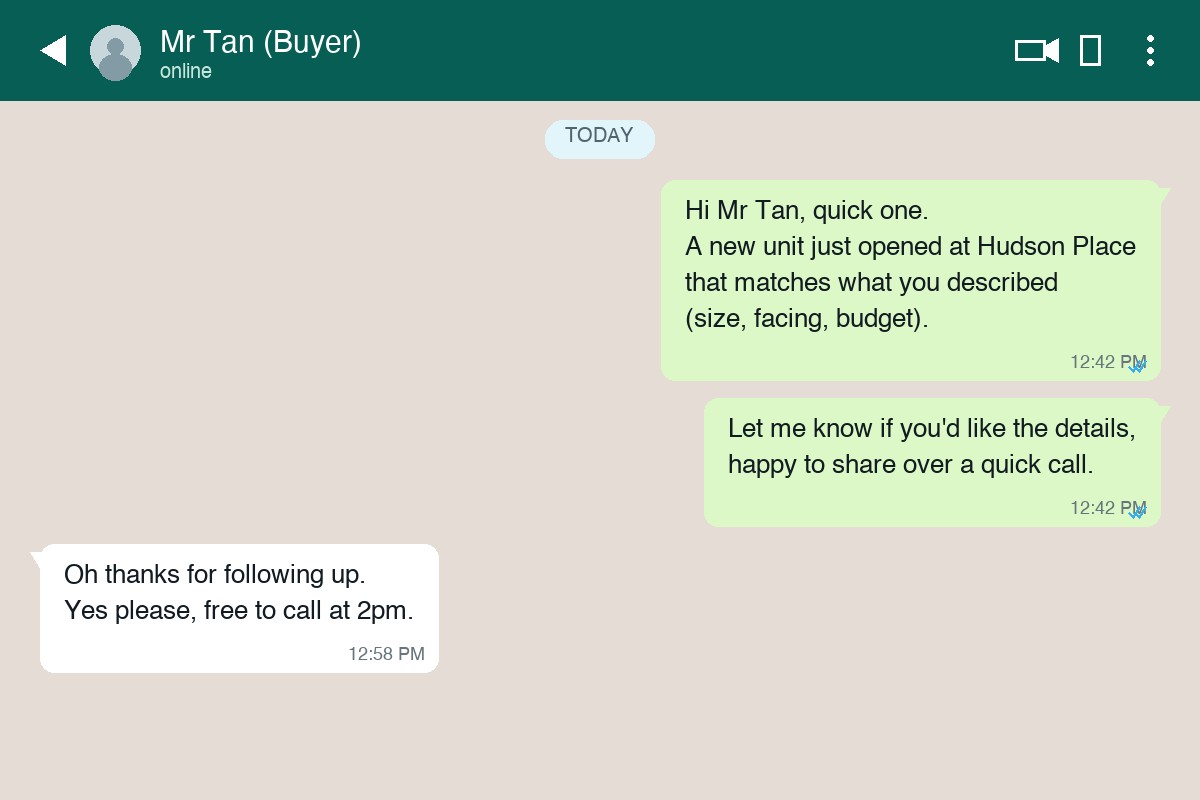
"Hi [Name], quick one. Unit #[xx-xx] at [Project] just opened up at [quantum]. It matches what you described (size, facing, budget). If it's still relevant, I can send the floor plan. If not, no worries, just let me know and I'll stop sending updates."
Why it works: One specific unit beats "still interested in [Project]?" every time. The opt-out at the end is the trust move. Leads reply to messages that respect their time.
Script 2: The two-question opener
When: You don't have a specific unit but need to restart the conversation.
"Hi [Name], two quick questions and you can reply with just a number: (1) Are you still looking in [area]? (2) Has your budget moved since we chatted? I'll match anything new in your range and send it over."
Why it works: Two numbered questions with a "just a number" reply path. Zero friction. Leads who ignore paragraphs reply to "1. yes 2. same."
Script 3: The "close the loop" permission script
When: Five to seven days of silence, you've sent one nudge already.
"Hi [Name], I'll close the loop on my side unless you'd like me to keep you posted. Happy to drop you from my active follow-up or keep sending the occasional market note, whichever you prefer. Just let me know."
Why it works: Most agents would rather spam than acknowledge silence. When you do the opposite, replies come back. Often the lead re-engages with "oh please keep me on the list, I've just been busy." Now you have explicit permission to follow up.
Scripts 4-6: Leads Who Went Silent After a Viewing (1-3 weeks)
Post-viewing silence is its own category. They saw the unit, gave polite feedback, and then disappeared. Usually the unit didn't click, or a competing agent entered the picture. Your job is to surface the real feedback without forcing it.

Script 4: The honest readout
When: 5 to 10 days after a viewing with no reply.
"Hi [Name], thinking about the viewing last [day]. Honest read from my side: [unit] felt like a stretch on [layout/facing/location], which is probably why it didn't feel right. If I've got that wrong, tell me. If I've got it right, I can line up 2 to 3 alternatives that fix that specific issue."
Why it works: You go first on the honest feedback. Most leads don't want to tell you the unit was bad, so they ghost. If you name it yourself, they either correct you ("actually the layout was fine, it's the price") or agree and let you re-engage with alternatives.
Script 5: The comparable-just-transacted data nudge
When: 2 to 3 weeks post-viewing. Use when a recent URA caveat or HDB resale transaction landed near what they were looking at.
"Hi [Name], a unit on the same stack as the one we viewed just transacted at [price] last week (URA caveat). Thought it's useful context in case you're still weighing it. No action needed from you, just sharing."
Why it works: A data point is not a pitch. You give without asking, which breaks the "he just wants the deal" frame. The specific caveat reference is credibility: it shows you're watching their deal even when they aren't.
Script 6: The real status change
When: Only when the unit they viewed has a verifiable change. Two scenarios that actually occur in Singapore new launches: (1) the developer releases a new early-bird or VVIP price tier with a hard deadline, or (2) the stack they liked is down to the last one or two units per the sales gallery's latest update. Do not use this script without one of those two triggers.
"Hi [Name], quick update on #[xx-xx]. Developer's early-bird tier ends [date], after which pricing resets up by about [amount]. Also, the stack you liked is down to 2 units per the sales gallery this week. If you'd ruled this one out, no worries. If you were still weighing, wanted to flag it before the window closes."
Why it works: Real urgency works. Fake urgency burns trust for years. The rule: never send this script unless the status change is documented (developer price sheet, sales gallery unit count). Do not invent "another buyer just put in an EOI" or similar pressure lines. Leads who catch you manufacturing scarcity ghost permanently, and word spreads faster than commission.
Scripts 7-9: Warm Leads Who Stopped Replying Mid-Process (3-8 weeks)
This is the category that stings. They were warm. You were exchanging messages, maybe discussing loan options, maybe drafting an OTP. Then silence. Usually something changed in their world (rate moved, job change, family input) or they quietly shifted to another agent. These scripts are designed to surface that without confrontation.
Script 7: The "price moved" data follow-up
When: A relevant transaction or launch in their target segment closes.
"Hi [Name], [Project / nearby comparable] just transacted at [price] this week. Thought of you because it's close to what we were looking at. Your earlier range was [range]. Situation on your end still similar, or has the window shifted? Either way is fine, just want to know what's useful to send."
Why it works: Data earns the reply. The open question at the end invites an update without demanding one. For the specific case where the silence came after the "too expensive" pushback, pair this script with the replies in Client Says "Too Expensive": 9 Replies Property Agents Can Use.
Script 8: The rate-cut / SORA-update script
When: MAS publishes new SORA data, a bank package changes, or HDB concessionary rate moves. Only send when something real changed.
"Hi [Name], SORA moved again this week. At current 3M SORA rates, on a [loan amount] loan over 25 years your monthly is now around [amount], which is about [$X] less than when we last ran the numbers. If the rate piece was the pause, this might be worth a second look. I can re-run the full stress-test if useful."
Why it works: You're the agent who watches their loan math even when they aren't. That's rare. For the full explainer on framing SORA conversations with buyers, see SORA Interest Rate Impact on Property Agents 2026.
Script 9: The "check-in without asking for anything" script
When: 4 to 6 weeks silent, no specific new data to share, but you want to leave a gentle touchpoint.
"Hi [Name], no agenda, just checking you're well. I know we'd paused the search. When (or if) you want to restart, I'm still here and happy to pick up where we left off. No pressure either way."
Why it works: Done once, this is disarming and often gets a reply. Done every two weeks, it's noise. Use it sparingly, maybe once per long-dormant lead, and never as a substitute for scripts that actually carry information.
How to tell if they bought from another agent: they reply politely but vaguely, no price questions, no interest in new listings. If three messages in a row look like this, they're gone. Send Script 11 and stop.
Scripts 10-11: Cold Leads (2+ months silent)
At this point, the relationship is dormant, not dead. Cold lead revival works when the re-entry is driven by genuine new value, not by you wanting to refill your pipeline.

Script 10: The market-update re-entry
When: A quarterly data release, a cooling measure, or a meaningful market event gives you a natural reason to re-appear.
"Hi [Name], been a while. Q1 URA flash is out: private residential +0.3% QoQ, transaction volume down 39.7% from Q4. If you'd parked the search, the volume drop means sellers are more flexible than they were 6 months ago. Happy to send a short market note for your target area if that's useful. Either way, hope you're well."
Why it works: You return with a real reason (market data), not a "just checking in." The implicit pitch is "conditions have shifted since you paused." Even if they don't re-engage now, you've re-established yourself as the informed source, not the hungry agent.
Script 11: The graceful exit
When: After two failed re-engagement attempts, or when it's clear the lead has moved on.
"Hi [Name], going to give you your space on the search. I'll drop you from active follow-up so I'm not clogging your inbox. If anything changes on your end, or you want a second opinion on something down the line, my number's always here. Take care."
Why it works: This is the script that wins you referrals 18 months later. Agents who grace-exit cold leads get remembered as the ones who respected time. Agents who never stop messaging get muted or blocked. Send this and actually stop. Then move the lead to a quarterly newsletter or a 90-day parking lot, not weekly DMs.
Timing Rules: When to Send and When to Wait
The best script at the wrong time underperforms the average script at the right time. Three rules govern the "when" for Singapore property WhatsApp:
Rule 1: Send at peak response windows. Singapore WhatsApp usage clusters around morning commute (7-9am), lunch (12-2pm), and evening (7-11pm). Evening messages generate the highest response rates. Mornings are high open rates but fewer replies (people are reading, not responding). For property enquiries, 12-2pm and 7-9pm are your windows.
Rule 2: Mid-week beats bookends. Tuesday to Thursday beats Monday (inbox catch-up) and Friday (weekend head-space). Avoid sending on Saturday or Sunday unless the lead has explicitly been responsive on weekends. Property decisions are weekday decisions.
Rule 3: The 72-hour gap rule. Never send two unanswered re-engagement messages within 72 hours. The blue-tick-no-reply is information; respecting it is how you stay human. If you feel the urge to "follow up my follow-up," that's the exact moment to stop.
Cadence by lead temperature:
| Lead state | Re-engagement cadence | Notes |
|---|---|---|
| Fresh enquiry, ghosted | Day 2, Day 5, Day 10 | 3 attempts, then park |
| Post-viewing, silent | Day 7, Day 14, Day 21 | One honest readout, one data nudge, one close-the-loop |
| Warm, stopped mid-process | Week 3, Week 6, Week 10 | Only send when something changed (rate, comparable, status) |
| Cold, 60+ days | Quarterly, event-driven | Market data or a graceful exit, not weekly DMs |
A disciplined cadence keeps you present without turning into the agent they mute. The one rule that ties it all together: every message must add something the lead didn't know before. If it doesn't, wait.
Stop losing silent leads at Day 14
PropPal tags every lead by silence window, triggers the right script at the right time, and runs your 3-strikes rule automatically. No spreadsheet, no sticky notes, no forgetting.
Get StartedWhat to Do When Even the Best Script Fails
Sometimes the lead is genuinely gone. Other times, the problem isn't the script, it's that you're handling 50+ chats in your head and missing the natural moments to re-engage. Here's the operator's triage:
The 3-strikes rule. Three re-engagement attempts, 72+ hours apart, each adding something new. If all three draw silence, stop. Move the lead to a 90-day parking lot (a WhatsApp label, a CRM tag, or a monthly calendar reminder). Revisit only when something material changes in the market or in your inventory.
Pass the lead to a team member. If you work in a team, a fresh voice sometimes unlocks a lead who had quietly decided they didn't click with you. No ego, no politics. Better a colleague closes than nobody does.
Archive with grace. The graceful exit (Script 11) does two jobs: it respects the lead's silence, and it leaves the door open for a referral or a future round. Agents who chase every ghost to the bitter end get a reputation. Agents who exit cleanly get remembered.
Fix the real problem: memory. The reason most agents lose "could-have-been-won" leads isn't the script, it's that they forgot the lead existed by week three. When you're running 50+ open WhatsApp threads, your head is not the right place to store "follow up with [Name] when SORA drops." The only reliable solution is a system that tags, reminds, and nudges on your behalf. That's covered in depth at How to Manage 50 Clients on WhatsApp as a Property Agent and at the system level in CRM vs Spreadsheet for Property Agents.
FAQ
How long should I wait before sending a re-engagement text to a property lead?
For fresh enquiries, wait 48 to 72 hours after your last message before the first re-engagement attempt. For leads who went quiet after a viewing, give them 5 to 7 days. For warm leads mid-process, 2 to 3 weeks is the right window. For cold leads over 2 months silent, anything less than a clear "market trigger" reason is noise. The rule: never send two unanswered messages within 72 hours.
Should I call or text a property lead who stopped replying?
Text first. A WhatsApp message gives the lead space to re-engage on their terms. About 80% of WhatsApp messages are read within 5 minutes, so you will know quickly if they are present but avoiding. Only call if the text surfaces genuine interest, or if the lead explicitly prefers calls. Cold-calling a silent lead almost always feels like pressure and accelerates the permanent ghost.
What if they read my WhatsApp but do not reply?
A "read but no reply" is information, not rejection. It usually means one of three things: they are busy and will reply later, they are comparing with another agent, or the message did not give them a clear reason to respond. Wait 72 hours. Then send one follow-up with something new: a specific unit, a data point, or a low-effort reply path like "yes or no?". If they still stay silent after two reads with no reply, move them to the 90-day parking lot.
Is it okay to send a voice note to a lead who stopped replying?
Only if you already had voice notes in your conversation history. A sudden voice note to a silent lead feels intrusive and is often skipped. For re-engagement, keep the message short, scannable, and text-based. Save voice notes for later in the relationship once they are actively replying again.
How many times can I follow up before I am being annoying?
Use the 3-strikes rule. Three re-engagement attempts, each with at least 72 hours between them and each adding new value (unit, data, question). If all three draw silence, move the lead to a 90-day parking lot and stop active follow-up. About 80% of sales close after 5 or more touchpoints, but only if the touchpoints add value. Repeated "just checking in" messages burn trust faster than silence does.
The agents who consistently recover silent leads in Singapore aren't the ones with the cleverest lines. They're the ones who match the script to the silence, send at the right hour, respect the 72-hour gap, and know when to grace-exit. Everything else is noise.
Save the 11 scripts above as WhatsApp quick-replies or in your CRM. The moment you catch yourself typing "just checking in," stop, open the silence-to-script map, and send the one that actually fits. That small swap is worth more commission per year than almost any other follow-up tweak. Pair this guide with the WhatsApp Follow-Up System for the complete cadence stack.
Sources
- URA. Release of flash estimate for 1st Quarter 2026 private residential property price index.
- ERA Singapore. 1Q 2026 URA Private Residential Report.
- Monetary Authority of Singapore. Singapore Overnight Rate Average (SORA).
- Hashmeta. Best Time to Post on WhatsApp Business: Messaging Strategy Guide.
- Hashmeta. WhatsApp Statistics Singapore: Messaging Trends and Business Opportunities.
- Colorlib. 50+ Sales Statistics: Benchmarks, Trends and Data (2026).
- 2xSolutions. How Many Follow-Ups To Close a Sale? Stats and Best Practices.